Body and mind

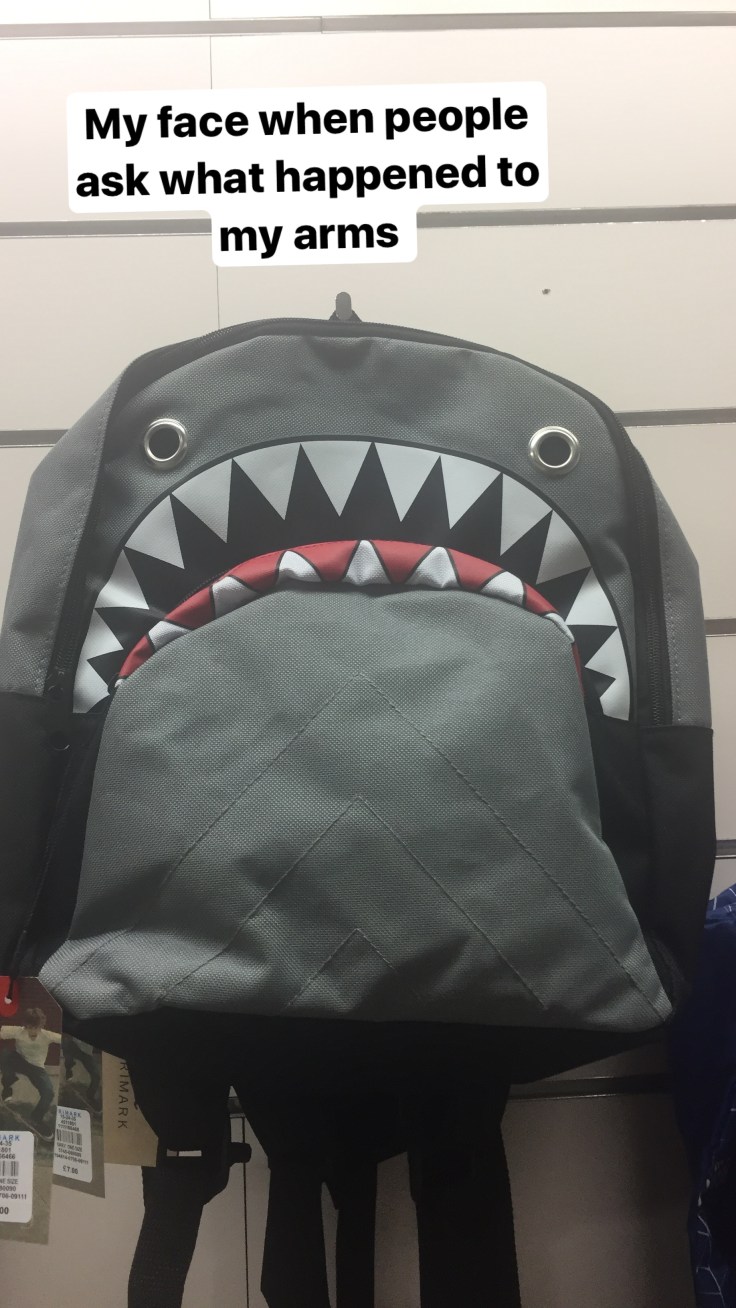
Shark bag
A picture of a shark rucksack looking anxious wih the caption “my face when people ask what happened to my arms”

*For the purpose of this post, I’ll be using the word disabled to mean people with a physical impairment. I do consider mental health problems to be a disability, but for clarity, I’ll refer to mental health separately.

So my brain whirred into action last night, thanks to an Instagram post by the amazing feeding of the fox. There’s a type of self-harm that’s rarely mentioned; self-neglect comes up in the context of depression.

I’ve never seen a discussion around the connection between disability or chronic illness and self-harm or disabled people deliberately not taking care of their physical needs as a way of self-harming. There are times when I say yes when I should say no, times when I will push myself because I don’t feel I deserve to rest. And times when I don’t take painkillers because it’s an indirect way of inflicting pain on myself, or going to places that aren’t accessible and doing things when I’m not well enough.

Any disabled person will also tell you there is a big divide in the treatment of physical and mental health problems, the two rarely mix, and the mental health services are not always good at recognising the impact that physical disability or chronic illness can have on mental health.

They don’t understand that the things that could benefit you mentally aren’t always possible physically (like going for a walk or having a bath). Being told I should do more exercise after I’ve explained that I have chronic pain and chronic fatigue can result in me feeling lazy and making myself do things that result in pain or injury and an increase in fatigue and related symptoms.

This is where the lack of understanding or knowledge of the connections between mental health and physical impairments is such a problem. For me, it can be an increase in symptoms, but for others, it can be much worse.

Then there’s the other side. Health services that treat your body as if your mind isn’t a part of it. Although I’ve always been disabled to some extent, in the last couple of years, my mobility has got worse, and I’ve been using mobility aids and dealing with more pain and fatigue.

At the beginning of 2017, I tried to access psychological therapy for long-term health problems. I wanted help accepting my chronic illness and dealing with no longer being able to do the things I used to and things people my age can do. I wanted some support in balancing my physical and mental health.

It took several months for them to tell me that they don’t offer support for chronic pain, between that they rejected me because I was under mental health services (I was in the process of being discharged and they were completely different services), they then said my self-harm made me too much of a risk and they said they didn’t think I’d be able to manage classroom based psychoeducation (thanks for that).

Last time I checked, neither my body nor my brain can function without the other, yet services treating each are still very separate and mental health services are often not accommodating for people with physical impairments. They often aren’t accessible, and there’s also an assumption that if you’re disabled and have mental health problems, then of course you’re depressed because you’re disabled, because who wouldn’t be?

Ableism, unfortunately, is still well-rooted within the medical profession and even within the disability communities, there is still too much separation of physical impairment and mental health issues.

Cost and sustainability

rant1
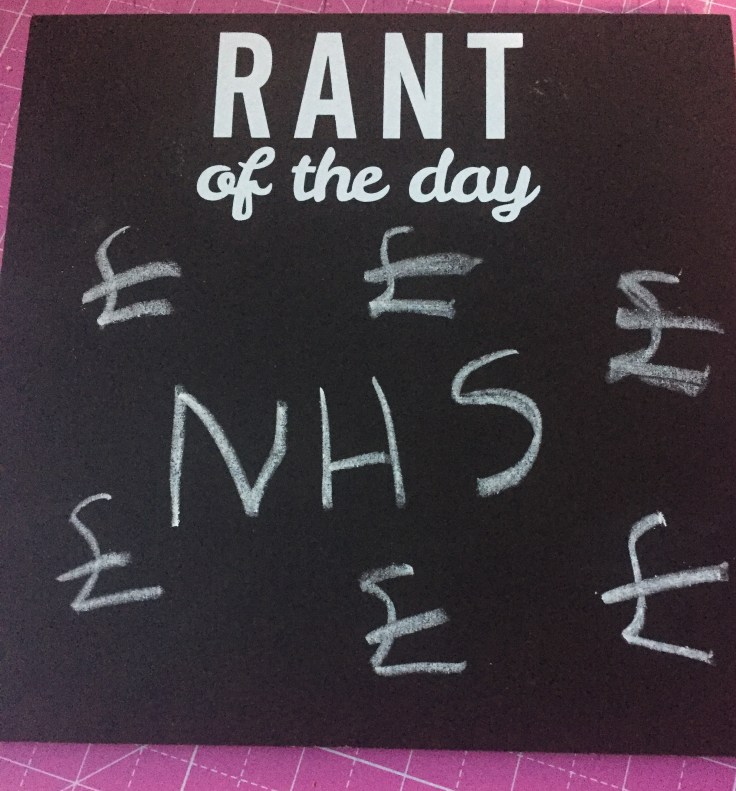
A blackboard with “rant of the day” printed at the top and the letters NHS with pound signs drawn in white chalk

I had a list of things I wanted to blog about, so instead I’m going to write about something completely different which came up a few days ago.

I’ve been trying to get more into doing activities outside of volunteering, which uses my lived experience of having mental health problems. Last week, I attended a workshop on Outcomes-Based Commissioning (OBC). I’ve learnt that mental health meetings and groups love acronyms, an alphabet soup of conditions, job roles, legislation and projects.

I’d like to tell you more about exactly what that is, but honestly, I’m not entirely sure myself. I can tell you that 8 organisations, some statutory such as the NHS and some charities are working together to change the delivery of mental health services in the area, and somewhere in all this, they’re looking for contributions and input from service users, carers and people with lived experience of mental distress.

One of the aims of the mental health service is to ensure sustainability and deliver cost-effective treatment. I have a couple of issues with this. 1) you cannot guarantee sustainability, you can do your best the make services sustainable but don’t make false promises especially to vulnerable people, 2) cost, now unless you’ve been living under a rock you’ll know that the NHS is chronically underfunded and overstretched; mental health has always been refereed to as the Cinderella service and when the going gets tough the tough gets cutting and mental health is often one of the first areas to feel these cuts.

So what’s the problem with pointing this out or looking to save money? well mental health already comes with a nice big serving of guilt for many people, guilt for putting pressure on loved ones, guilt for not working, guilt for being unreliable and it’s hard not to feel the need to justify the cost of treatment as I wrote in my last post I’ve been told by doctors in A&E to consider how long it took to treat me compared to the time it took me to cut myself, I’ve been questioned on why I called an ambulance despite feeling faint from blood loss. I didn’t choose to have mental health problems; my actions may be my choice, but having these issues is something beyond my control.

Having the cost of treatment pointed out or hearing the providers talk about services being cost-effective makes people feel guilty for something they can’t help and even puts people off seeking treatment, whether that’s for self-harm (I know people who will suture or glue themselves) or more long-term treatment like psychotherapy or counselling.

The financial situation with the health service is complex, but nobody should be made to feel guilty for needing healthcare or social care or feel they don’t deserve the help they need.

Dear Dr (a message to Healthcare professionals treating self harmers in hospital)

I’m a regular at my local, which probably doesn’t sound unusual or uncommon, except that I don’t mean my local pub; I mean my local A&E department. Like around 1 in 4 people in the U.K. I have mental health problems and often require medical attention for self-harm. I decided to write a post about my experiences in A&E as an open letter to medical professionals.

Dear Dr or health care professional

The NHS is underfunded and over stretched, you work long hours in challenging conditions, often with little thanks or support; it’s impossible to be oblivious to the current state of our health care system. When you’re juggling patients and trying to be in 3 places at once it’s not hard to understand why you might not want to spend an hour or more treating someone for self inflicted injuries especially when you’re coming to the end of a long shift; however you chose a career helping people and taking care of their medical needs and I am a person in need of medical attention.

If you’ve never experienced a mental health problem or felt a need to harm yourself, then I don’t expect you to understand how I feel or why I do what I do, but the way I got my injuries doesn’t change the way they should be treated. I’ve been treated in ways I can’t imagine people who are there after an accident would be.

I’ve had wounds washed out in a sink in front of all the other cubicles and taken from one part of the department to another with nothing covering my arm while people stare at me, often horrified. On one occasion, my arm was covered so it wouldn’t scare the children in the paediatric A&E.

I’ve been stapled with no local anaesthetic and told it’s fine because it doesn’t hurt (it does), I know this is in partly due to guidelines but I’ve also had malicious treatment where one doctor repeatedly pulled the staples out and re did them all the while telling me if I didn’t stop I’d lose my arm while I sat in bed crying. I’ve had doctors tell me to think about how long it took them to treat me compared to the time it took me to hurt myself, and when I’ve felt faint from blood loss and said I need to sit down, I’ve been told I can wait a couple of minutes.

In my A&E notes, it says most of the time that I’m not distressed or that I was making eye contact; apparently, that means I’m fine. My mental state is frequently judged as fine because I’m not shouting or being abusive or absconding; however, at times when I have been visibly upset, I’m ignored.

I know accident and emergency staff are there to treat my physical injuries and leave the psychological side of things to the psych liaison but please remember that attached to the arm you’re treating is a person, I know my cuts can be deep and you may need another opinion but I’m not an exhibition for everyone to come and have a good look and discuss the damaged I’ve done, I see the signs that talk about dignity privacy and respect yet that doesn’t seem to apply if you’re a mental health patient; a little discretion wouldn’t hurt.

This isn’t intended as a criticism of the NHS; I know I’d be dead without it, but I didn’t choose to be this way; it’s something I’ve not been able to break away from despite treatment, and no amount of snapping elastic bands or holding ice cubes has ever replaced it as a coping mechanism.

Website Powered by WordPress.com.

Up ↑