Managing

I don’t have an issue with taking the easier option. I’m not going to take the harder way of doing something if an easier option is available. Why struggle to add something up if there’s a calculator available? Why carry a suitcase if it has wheels? Why use a tin opener if there’s a ring pull?

But when it comes to being disabled, I tend to manage before going for the easier option or the option involving using aids or adaptations, I’m more hesitant to do what’s easiest. Some of this is about other people’s perceptions or questions.

When I first started using mobility aids I was so anxious about what people would say because I was going from having an invisible disability to a visible one and suddenly people became aware of the accommodations I needed (not completely but more than they had) you can thank social anxiety for me not asking for accommodations before or even after I still prefer things like badges or lanyards to talk for me.

My partner recently moved, and his new flat has a bath with a shower attached, but there are no handles or grab rails; at home, my bath has handles and a grab rail, and that’s a struggle. I put grippy duck stickers in the bath. I told myself it was fine and I could manage, but then I caved and got a shower seat. Of course, I still questioned whether I needed it because I was managing without.

A white slatted shower stool in a white bathtub
The latest accessory

On Monday, I used my shower stool, and it really made things easier. I could spend longer in the shower, I used up less energy, was less anxious about falling over, and I was able to wash my legs and feet without the risk of falling.

Managing isn’t everything. I can manage to walk unaided, but it’s harder, causes more pain and fatigue, and I’m more likely to fall over. I could manage at cons and outdoor events without using my crutches, but it would be exhausting, my hips would hurt so much I wouldn’t be able to walk the next day, and I wouldn’t be able to manage without a lot more help than I already get, especially on wet or uneven ground.

Sometimes it’s not enough to just manage, and if there is a way to make things easier, don’t settle for managing.


Sing little darling

Sing with me

Blue, green, red and white laser beams pointing in all directions around s concert venue

I love live music. I love going to gigs, even though I don’t do it that often; it’s something I really enjoy. As a rather emo teenager, I’d queue up in the cold wearing just jeans and a t-shirt, arriving several hours early to guarantee a place at the front by the stage with only the bare minimum of possessions with me to avoid the need for a bag. I would far rather be crushed and sweaty in the mosh pit than sensibly seated or in the less crowded areas at the back.

My first and only festival experience was not something I’m keen to revisit. Between the lack of sleep, disrupted medication schedule, and discomfort of camping, day festivals and open-air gigs are more my thing with a comfortable bed to return to

The days of post-gig highs from adrenaline and lack of sleep have been replaced by planned annual leave the day after a night out to recover. I can’t stand for anywhere near the length of time a gig lasts, and the crowds bumping and pushing me not only increase my anxiety but also cause physical pain and rock my already shaky balance.

Today I’m paying for last night, although the pain and exhaustion are worth it for such a good time seeing First Aid Kit, a band that, although I haven’t been following for long, I’m now a big fan of and really love the music of. They’re also amazing live, but despite some of the perks of going to a gig as a disabled person, such as queue jumping or getting a carers ticket for free, I do wish I could still be near the front and not forced to be seated out of necessity.

Body and mind

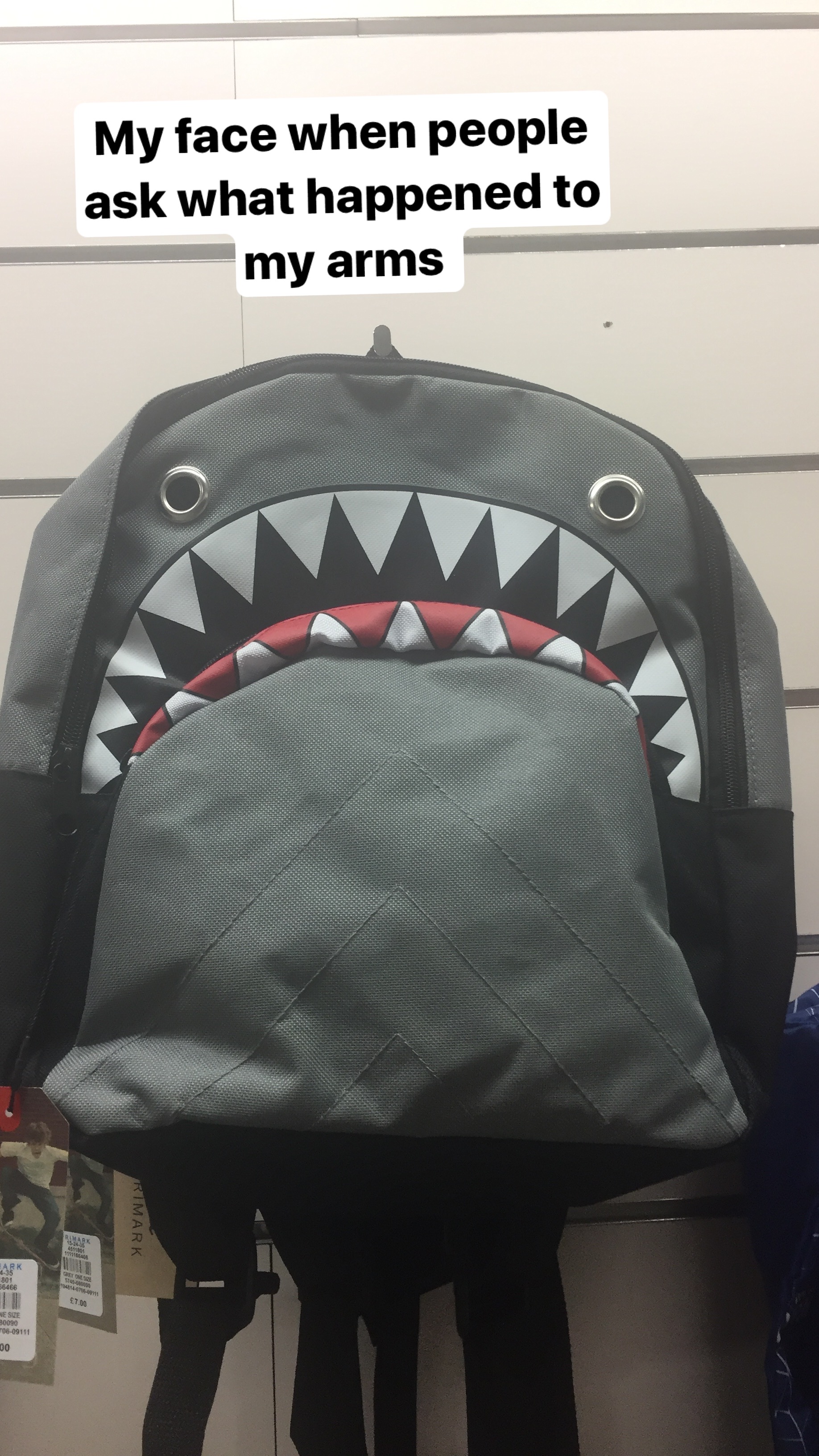
Shark bag
A picture of a shark rucksack looking anxious wih the caption “my face when people ask what happened to my arms”

*For the purpose of this post, I’ll be using the word disabled to mean people with a physical impairment. I do consider mental health problems to be a disability, but for clarity, I’ll refer to mental health separately.

So my brain whirred into action last night, thanks to an Instagram post by the amazing feeding of the fox. There’s a type of self-harm that’s rarely mentioned; self-neglect comes up in the context of depression.

I’ve never seen a discussion around the connection between disability or chronic illness and self-harm or disabled people deliberately not taking care of their physical needs as a way of self-harming. There are times when I say yes when I should say no, times when I will push myself because I don’t feel I deserve to rest. And times when I don’t take painkillers because it’s an indirect way of inflicting pain on myself, or going to places that aren’t accessible and doing things when I’m not well enough.

Any disabled person will also tell you there is a big divide in the treatment of physical and mental health problems, the two rarely mix, and the mental health services are not always good at recognising the impact that physical disability or chronic illness can have on mental health.

They don’t understand that the things that could benefit you mentally aren’t always possible physically (like going for a walk or having a bath). Being told I should do more exercise after I’ve explained that I have chronic pain and chronic fatigue can result in me feeling lazy and making myself do things that result in pain or injury and an increase in fatigue and related symptoms.

This is where the lack of understanding or knowledge of the connections between mental health and physical impairments is such a problem. For me, it can be an increase in symptoms, but for others, it can be much worse.

Then there’s the other side. Health services that treat your body as if your mind isn’t a part of it. Although I’ve always been disabled to some extent, in the last couple of years, my mobility has got worse, and I’ve been using mobility aids and dealing with more pain and fatigue.

At the beginning of 2017, I tried to access psychological therapy for long-term health problems. I wanted help accepting my chronic illness and dealing with no longer being able to do the things I used to and things people my age can do. I wanted some support in balancing my physical and mental health.

It took several months for them to tell me that they don’t offer support for chronic pain, between that they rejected me because I was under mental health services (I was in the process of being discharged and they were completely different services), they then said my self-harm made me too much of a risk and they said they didn’t think I’d be able to manage classroom based psychoeducation (thanks for that).

Last time I checked, neither my body nor my brain can function without the other, yet services treating each are still very separate and mental health services are often not accommodating for people with physical impairments. They often aren’t accessible, and there’s also an assumption that if you’re disabled and have mental health problems, then of course you’re depressed because you’re disabled, because who wouldn’t be?

Ableism, unfortunately, is still well-rooted within the medical profession and even within the disability communities, there is still too much separation of physical impairment and mental health issues.

The most wonderful time of the year?

IMG_6234
A rather appropriate Christmas card I saw last year

I don’t like Christmas, call me Scrooge or the Grinch, but I really don’t enjoy it. Christmas can be a really difficult time for so many people. There’s a big emphasis on joy and happiness, being around family and friends, but the happy family isn’t a reality for many.

My family diminished over the years, with elderly members moving into nursing homes and dying. Now I have no contact with my immediate family, though the family Christmases I did have were rarely happy ones.

My mental health tends to deteriorate around this time of year, the run-up to Christmas really makes me stressed and anxious, despite knowing rationally that the day itself will most likely be fine and that I’m actually going to spend it with two people (and two cats) that I’m choosing to be with.

One of the struggles I have with Christmas is that most of the things I do to support myself aren’t an option. I’m off work for two weeks, there’s a big reduction in public transport, so as a non-driver, I’m limited on how much I can get out. Health services are reduced, as are most other things like council services and housing association (not that my housing association is any use when they are in). It feels like the world shuts down, and the prospect of over a week with nothing to do doesn’t fill me with joy but anxiety.

I need routine and structure to stay relatively sane (emphasis on relatively), though this structure is mainly external, as left to my own devices, I tend to spend too much time in bed or watching YouTube.

The idea of days with nothing to do and falling back into bad sleep patterns reminds me of when that was all my life consisted of. Endless days of nothing stretching out ahead of me, with little point in knowing what day it was when they were all the same. I’d stay up half the night and sleep half the day (this was mainly a way of reducing the amount of time I had to spend around my mother), although however much I need routine, I’m not missing getting in at 8:30 to prepare for volunteer training.

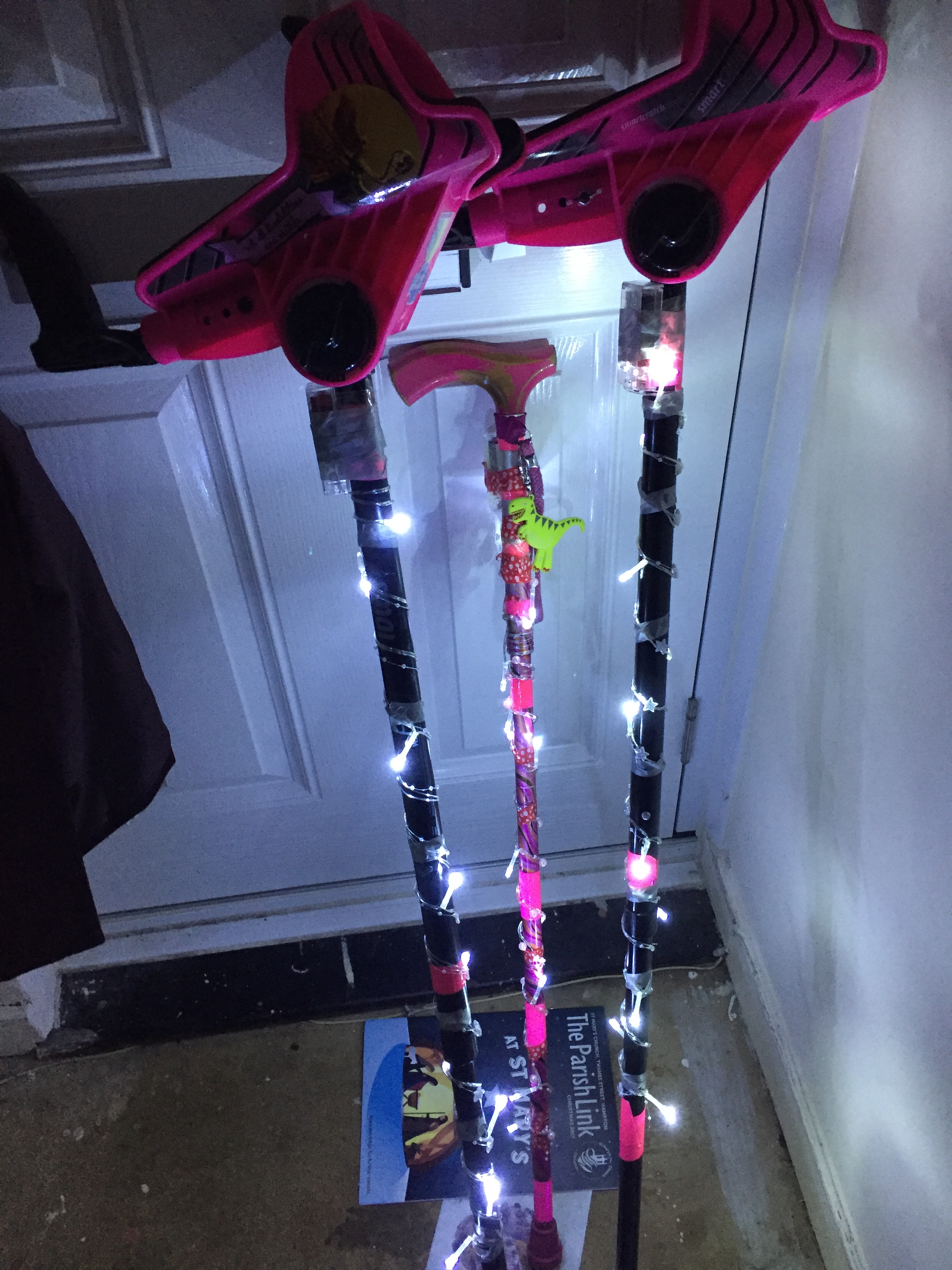
IMG_6072
My attempts at festivity, fairy lights wrapped around my crutches and stick

Christmas is also shortly followed by New Year, and the thought of change and reflection, I’ve been reflecting a lot recently, especially on relationships. I’m tired of missing people, especially people who don’t miss me, who made promises they didn’t mean. I don’t want to miss them anymore. In January, I’ll be once again going through medication changes in an attempt to finally get off antipsychotic medication, something I’ve been wanting for a while.

Disability, chronic illness and mental health problems don’t go away for the holidays; it just means different challenges and things that can affect pain or fatigue and trying to manage pacing while still enjoying the day.

To anyone struggling this Christmas, with isolation, pain or mental illness, you’re not alone. This dinosaur sends love and solidarity. If you need support during the Christmas period, the Samaritans are always there, and comedian Sarah Millican will once again be doing #joinin on Twitter for the 7th year running. Have as good a Christmas as you can, a big Christmas RAWR from The Perks of Being a Dinosaur.

Website Powered by WordPress.com.

Up ↑